Tuesday, May 27, 2025

Discover Sri Lanka's Hidden Gem: The Scenic Pekoe Trail


If you are looking for a unique experience in Sri Lanka, the Pekoe Trail is the answer because it is quickly emerging as one of the country's best-kept secrets. The 300km hiking trail winding through the heart of the island’s famed tea country offers stunning landscapes, cultural immersion, and a peaceful escape from the usual tourist spots.


What Is the Pekoe Trail?

It is a 300-kilometer (186-mile) hiking route that traverses Sri Lanka's central highlands. Named after the "pekoe" grade of tea and this trail connects the historic tea plantations of Kandy, Nuwara Eliya, Hatton, Ella, and other picturesque towns.

Lush forests, terraced tea fields, and misty mountain ridges, developed with sustainable tourism in mind, the trail passes through remote rural villages. The Pekoe Trail is designed for both short hikes and long-distance trekking, with 22 stages that can be done individually or as part of a multi-day adventure.


What makes the Pekoe Trail a Must-Visit?

1. Breathtaking Scenery

Rolling tea hills, exploring waterfalls and wildlife, and 360-degree mountain views every step of the trail reveal something new. It is a photographer’s dream and a peaceful retreat for hikers because of its ever-changing landscape.

2. Cultural Immersion

Mostly, you will interact with local tea pluckers, visit century-old tea estates, and explore Hindu temples and colonial-era towns along the trail. The Pekoe Trail is an intimate glimpse into the daily life of Sri Lanka's hill country.

3. Sustainable & Responsible Tourism

By promoting homestays, local guides, and community-run businesses, The Pekoe Trail supports local economies and is an ideal way to travel responsibly and support rural development in Sri Lanka.


Best Time to Hike the Pekoe Trail

January to April and July to September are the best months to hike the Pekoe trail when the weather is dry and the skies are clear. But please remember to check local weather forecasts before you go, as conditions can vary by region.


How to Get There

The Pekoe Trail can be accessed from major cities like Kandy, Colombo, and Ella via public transport or private vehicle. Many hikers start from Kandy or Hatton, depending on their itinerary.


Consider the following things.

  • Wear comfortable hiking shoes
  • Wear lightweight clothing and layers
  • Bring Rain gear (especially during monsoon season)
  • Apply Sunscreen and insect repellent
  • Use a reusable water bottle
  • Bring some snacks and a camera

Useful Tips for Hiking the Pekoe Trail

  • For meaningful insights and safer trekking, hiring a local guide is a good idea.
  • Support the local communities by staying in eco-lodges or homestays.
  • Always respect the locals and ask their permission to photograph.
  • Downloading the offline maps is also a good idea because phone signals may be weak in remote areas.

Final Thoughts

The Pekoe Trail is a journey through Sri Lanka’s rich natural beauty, history, and culture, and not just a hike. The trail offers something unforgettable for everyone, whether you’re a seasoned trekker or a casual nature walker,

The Pekoe Trail stands out as a shining example of eco-tourism done right as Sri Lankan tourism continues to recover and grow.


Sunday, May 11, 2025

How Shift Cultivation Helps to Restore Soil Fertility


Traditional chena cultivation plot in Sri Lanka


We often focus on what we see on the surface — the crops, the harvest, the markets when we talk about farming and food. But beneath it all, the real star of the show is the soil.  There’s no healthy food, no strong crops, and no sustainable farming without healthy soil. That’s why it’s worth taking a closer look at shift cultivation — or, which is locally known in Sri Lanka, “chena” — and how it quietly protects one of our most precious resources: soil fertility.


What Exactly Is Shift Cultivation?

Shift cultivation is one of the oldest farming methods in Sri Lanka, especially in the dry zone of Sri Lanka. Here’s how it works: farmers clear a patch of forest, burn the leftover vegetation, and plant crops like maize, millet, or pumpkins for a season or two. Then — and this is the key part — they leave that land alone for several years so the forest can grow back and the soil can naturally recover.


It might sound simple, even old-fashioned, but it’s a smart way to work with nature instead of fighting against it.


How Does It Help the Soil?

1. Ash Brings Nutrients Back

When vegetation is burned during land clearing, the ash left behind is full of nutrients like potassium and phosphorus, which help the crops to grow. It’s nature’s version of a fertilizer, just without the chemicals.


2. Letting the Land Rest

One of the best things about shift cultivation is the built-in fallow period. After farming a piece of land for a short time, farmers move on and let that area rest, sometimes for years. This gives the soil time to bounce back, regain nutrients, and rebuild its natural ecosystem. It’s like giving the land a much-needed nap.


3. Less Tilling Means Less Damage

Chena farming usually involves light tilling, if any. That’s a good thing because it keeps the soil structure intact, reduces erosion, and helps the land hold on to water and nutrients. In contrast, heavy plowing in modern farming can wear the soil out quickly.


4. Growing More Than One Crop

Farmers who use shift cultivation often plant a variety of crops together. This kind of mixed farming helps the soil stay balanced and healthy, since different crops use and return different nutrients. It’s also great for biodiversity and pest control.


5. No Need for Synthetic Fertilizers

Because the Shift Cultivation method relies on natural processes and organic materials, there’s little to no use of chemical fertilizers. That’s good news for both the soil and the surrounding environment, especially rivers and water sources that often suffer from chemical runoff in large-scale farming.


Sri Lankan farmer practicing mixed cropping

But It’s Not Without Challenges

Shift cultivation also has its risks, like any other farming method. As more land is needed and fallow periods get shorter, there’s a danger of soil depletion and deforestation. Some areas are also seeing pressure from development or large-scale agriculture, which can push out these traditional practices.


However, with the right support, like training, land-use planning, and community forest management, this time-tested method can continue to play a powerful role in sustainable farming in Sri Lanka.


Why It Still Matters Today

In a world where agriculture is often dominated by machines, chemicals, and overworked soil, shift cultivation offers a reminder: nature knows what it’s doing. When we slow down, listen, and let the land recover, the results speak for themselves — richer soil, better crops, and a healthier environment.


This is not just a way to farm — it’s a way to live in harmony with the land for Sri Lankan farmers who still practice chena cultivation. And in today’s climate-conscious world, that’s a lesson worth remembering.

Sunday, April 27, 2025

🐓 The Sri Lanka Junglefowl — The Proud National Bird of Sri Lanka


During my journey as a naturalist across the lush landscapes of Sri Lanka, I’ve encountered some incredible wildlife. But one encounter always feels special — spotting the Sri Lanka Junglefowl (Gallus lafayettii), the proud national bird of this beautiful island.

🌿 A Bird Found Nowhere Else

The Sri Lanka Junglefowl is endemic to the island, meaning it doesn’t live anywhere else on Earth. It's a true symbol of the island’s unique biodiversity.
The male is a showstopper:
✨ Shimmering orange-red plumage
✨ A bright red comb on top of his head
✨ A golden-yellow patch on the comb (one of the key differences from domestic chickens)

The females, in contrast, wear more earthy brown feathers — nature’s camouflage — perfect for blending into the undergrowth and keeping their chicks safe.

🏞️ Where They Roam

You’ll find Junglefowl mostly in dense forests, scrubby woodlands, and even near village gardens. They are quick on their feet, darting between bushes, scratching the ground for seeds, insects, and fallen fruits.
Early mornings or late afternoons are the best times to see them — often heard before they are seen, with their loud, distinct crowing echoing through the trees. 🐣

🌺 Deep Roots in Sri Lankan Culture

Long before it was officially declared the national bird in 1963, the Junglefowl already had a place in the hearts of the Sri Lankan people.
🗿 Ancient temple carvings show chicken-like birds that resemble today’s Junglefowl.
🎭 In folklore, it symbolizes vitality, pride, and the spirit of the land.

In a way, seeing a Junglefowl in the wild feels like witnessing a living connection to ancient Sri Lanka — a vibrant reminder of when the forests ruled and nature’s rhythms set the pace.

💬 Final Thoughts

Every glimpse of the Sri Lanka Junglefowl is a moment worth holding onto — a small but powerful reminder that wild beauty still thrives on this island nation. 


If you ever visit Sri Lanka, listen carefully when you're walking through the woods... You just might hear their proud call rising through the trees. 🐓✨

Wednesday, April 9, 2025

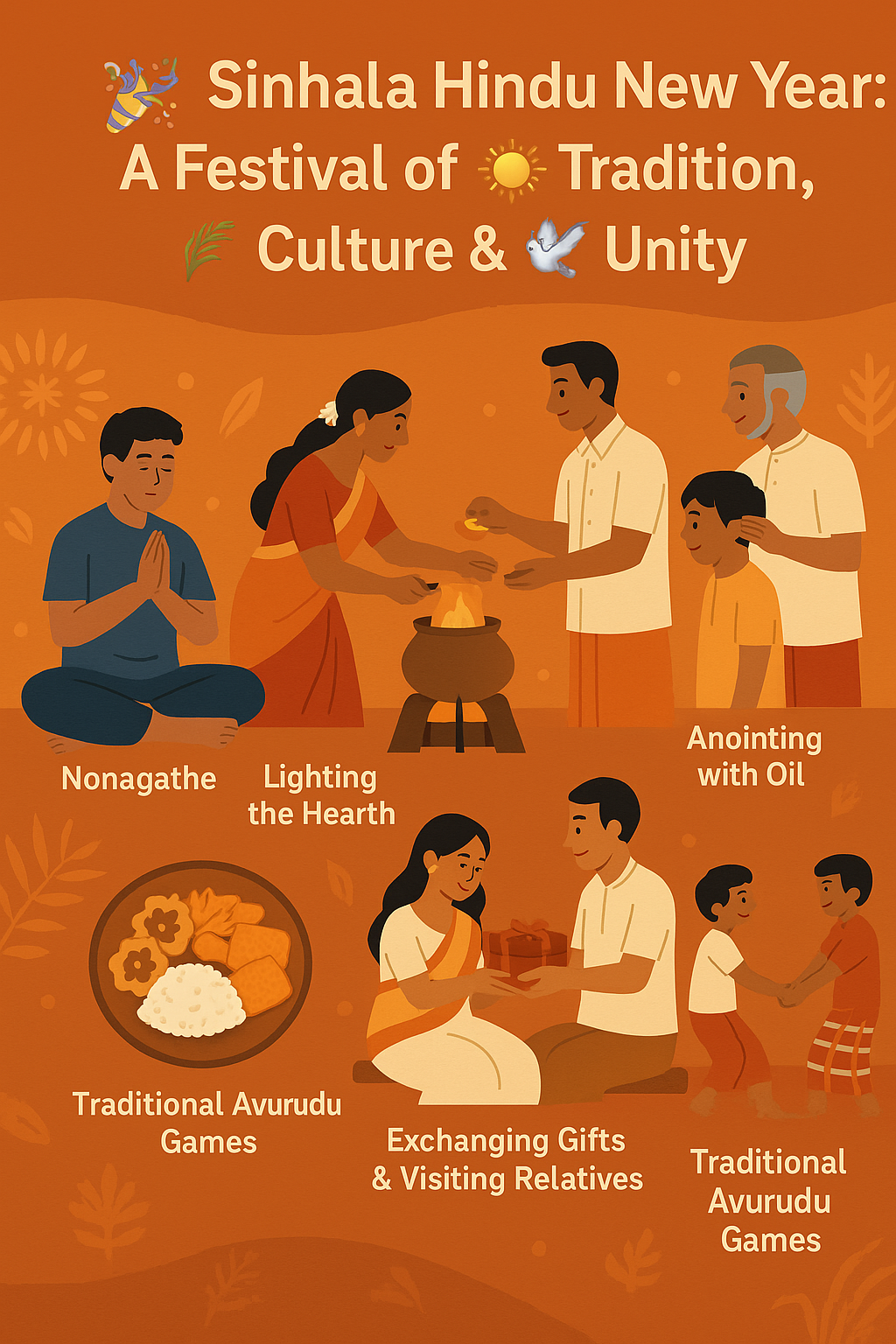
🎉✨ Sinhala Hindu New Year: A Festival of 🌾 Tradition, 🌞 Culture & 🕊️ Unity


The Sinhala Hindu New Year — known as 🎊අලුත් අවුරුද්ද (Aluth Avurudu) in Sinhala and 🎊புத்தாண்டு (Puthandu) in Tamil — is one of the most colorful and joyful festivals in 🇱🇰 Sri Lanka. It marks the end of the old year and the 🌅 beginning of a new solar year, symbolizing renewal, peace, and prosperity. 🌸


📅 When Is Sinhala Hindu New Year Celebrated?

🗓️ Celebrated around April 13th or 14th, this New Year begins when ☀️ the sun transitions from ♓ Pisces (Meena Rashiya) to ♈ Aries (Mesha Rashiya). Unlike the Western New Year, this is based on astrological and agricultural cycles 🌿 — a celebration of life, nature, and community.


🤝 A Festival of Unity: Sinhala & Tamil Together 🇱🇰

This celebration is unique because both Sinhala Buddhists and Tamil Hindus honor it with their own rituals but with shared joy 💞. It’s a time of togetherness, gratitude, and cultural harmony — a true symbol of unity in diversity 🌈.


🔔✨ Key Sinhala Hindu New Year Traditions

Here are some magical moments that make the Sinhala and Tamil New Year unforgettable:

🕰️ 1. Nonagathe (නොනගතය) – Inauspicious Time

During this quiet time, work is paused. Instead, people engage in 🙏spiritual activities, like visiting temples and spending quality time with family 👨‍👩‍👧‍👦.

🔥 2. Lighting the Hearth (ලිප ගිණි මෙලවීම )

At the auspicious hour ⏰, families light the hearth to cook 🥥🍚Kiribath (milk rice) — a sacred dish that represents blessings and abundance 💫.

💰 3. First Transaction (ගණුදෙනු කිරීම )

Whether it's earning, spending, or planting, the first action of the year — done at the right time — is believed to bring success 💼 and good fortune 🍀.

💆‍♂️ 4. Anointing with Oil (හිසතෙල්  ගෑම)

With herbal oil and traditional chants 📿, elders bless younger family members for health, happiness, and strength 🧘.

🎁 5. Exchanging Gifts & Visiting Relatives

From sweet platters 🍬 to warm hugs 🤗, this is a time for sharing love and reconnecting. Visiting friends and family creates a wave of unity and laughter 💐.

🪅 6. Traditional Avurudu Games (අවුරුදු  ක්‍රීඩා)

Communities come alive with games and fun! Think:
🎯 Kana Mutti Bindeema (Breaking the Pot)
💪 Tug-of-War
🪑 Musical Chairs
😂 Pillow Fighting

These playful moments bring joy to everyone — young and old alike 🎈!


🍽️ Delicious Sinhala New Year Foods

A Sinhala New Year table is a feast for the senses! 🌟 Common treats include:

  • 🥞 Kokis (crispy rice flour snack)

  • 🍯 Kavum (oil cakes)

  • 🍬 Aluwa

  • 🌾 Mung Kavum

And, of course, the star of the table: Kiribath served with lunu miris or jaggery. Every bite is a taste of tradition 🥥❤️.


🔮 Astrology & Auspicious Moments

Every ritual — from lighting the fire 🔥 to starting work 💼 — follows precisely timed Nekath (නැකත) based on ancient astrology 📜. This spiritual connection to the cosmos adds meaning and reverence to each act 🕊️.


🌟 Final Thoughts

The Sinhala Hindu New Year is not just a date — it’s a celebration of identity, heritage, and unity. Whether you’re Sinhala, Tamil, Buddhist, or Hindu, this season invites us all to:
✨ Forgive the past
🌱 Embrace the future
💞 Celebrate togetherness


🎉 සුබ අලුත් අවුරුද්දක් වේවා! | இனிய புத்தாண்டு வாழ்த்துக்கள்! 🎉
Wishing you a Happy Sinhala and Tamil New Year filled with love, health, and prosperity!

Thursday, March 27, 2025

🌴✨ How to Blend with Locals in Sri Lanka: A Guide to Authentic Connections ✨🌴


Sri Lanka, the "Pearl of the Indian Ocean," isn’t just about stunning beaches and lush landscapes—it’s the people who make the island truly special. 🥰 To experience the heart of this beautiful country, connecting with the locals is key! Here’s your ultimate guide to blending in and creating unforgettable memories. 🌟

1. Greet with a 😊 Smile and learn a Few Local Phrases 💬

A smile is universal! Pair it with a few Sinhala or Tamil words to impress and connect with the locals.

👉 Sinhala phrases to try:

  • "Ayubowan" 🙏 (Hello/May you live long)

  • "Bohoma Istuti" 🙌 (Thank you very much)

👉 Tamil phrases to try:

  • "Vanakkam" 🙏 (Hello)

  • "Nandri" 💛 (Thank you)

💡 Pro Tip: Your effort will be met with big smiles and warm appreciation!


2. Embrace Sri Lankan Hospitality 🫖🍛

Sri Lankans are famous for their generosity. Don’t be surprised if you’re invited for a cup of tea 🍵 or a homemade meal. Sharing food is a beautiful way to bond.

Remember: Always accept with your right hand as a sign of respect.


3. Dress Modestly, Especially at Temples. 🕉️

When visiting sacred sites like temples or shrines, respect their traditions by dressing modestly.

✨ Cover your shoulders and knees.
✨ Remove your shoes before entering.

💡 Carry a shawl or scarf for convenience—it's practical and stylish!


4. Savor Local Delicacies 🍛🥥

Food brings people together, and Sri Lanka’s cuisine is a feast for your taste buds! 🤤 Explore small eateries or street food stalls to try:

  • Kottu Roti 🍳

  • Hoppers 🥞

  • Pol Sambol 🥥

💡 Pro Tip: Eating with your hands is common and a fun way to engage with locals! (Give it a shot—it's easier than you think!)


5. Respect Local Customs and Traditions 🛕🙏

Sri Lanka is steeped in tradition, and respecting it goes a long way.

🚫 Avoid public displays of affection.
📸 Always ask permission before taking photos.
⏳ Be patient—Sri Lankans live life at a relaxed pace.


6. Join Vibrant Local Festivals 🎉

Sri Lanka’s festivals are colorful, spiritual, and lively. Participating in them is the perfect way to experience the culture up close.

✨ Don’t miss:


7. Travel Like a Local 🚂🛺

Hop on a tuk-tuk, bus, or train to experience the real Sri Lanka! 🛤️ The Ella train ride is a magical journey where you can meet locals and share stories.


8. Support Local Businesses 🛍️🌟

Buy handmade crafts, shop at bustling markets, and stay in family-run guesthouses. Your support helps the community and builds meaningful connections.


9. Be Curious and Respectful 🌏

Ask questions about Sri Lanka’s history, traditions, and daily life. Locals love sharing their stories and will appreciate your interest.

💡 Pro Tip: Approach conversations with an open mind and genuine curiosity.


10. Give Back to the Community 🤝

Want to make your trip meaningful? Volunteer with local organizations or support community projects to leave a positive impact while creating bonds. 💖


Final Thoughts 💭

Blending with locals in Sri Lanka is about more than just learning customs—it’s about building authentic connections. Show respect, embrace the culture, and cherish every interaction. 🌿✨

Have you ever connected with locals during your travels? Share your story in the comments!👇

Wednesday, March 12, 2025

Exploring Ravana Temples in Sri Lanka: Tracing the Footsteps of a Legendary King


Sri Lanka, an island steeped in history and mythology, is often linked to the legendary King Ravana from the Indian epic Ramayana. According to ancient tales, Ravana was a mighty ruler and a scholar, warrior, and devotee of Lord Shiva. Across Sri Lanka, several temples and sacred sites are believed to be associated with him, attracting devotees, historians, and curious travelers alike.

This blog explores some of the most fascinating Ravana temples and sites that continue to preserve his legacy.

1. Ravana Cave and Temple – Ella

One of the most famous sites linked to Ravana is the Ravana Cave and Temple, located near the picturesque town of Ella. According to legend, Ravana kidnapped Sita, the wife of Lord Rama, and hid her in these caves. The cave system is said to be part of an ancient underground network used by Ravana and his soldiers.

📍 Location: Near Ella, Uva Province
🔎 What to See: The temple at the base of the cave, ancient tunnels, and breathtaking views from the top.


2. Koneswaram Temple – Trincomalee

The Koneswaram Temple, dedicated to Lord Shiva, is an important Hindu pilgrimage site. It is believed that Ravana was a devout Shiva worshipper and once meditated here to gain divine powers. The temple stands atop Swami Rock, offering stunning views of the Indian Ocean.

📍 Location: Trincomalee, Eastern Province
🔎 What to See: The temple’s intricate Dravidian architecture, ancient lingams, and the famous “Lover’s Leap” cliff.


3. Sri Bhadrakali Amman Temple – Munneswaram

Located in Chilaw, the Munneswaram Temple complex is another sacred site with ties to the Ravana legend. It is believed that after the war with Lord Rama, Ravana sought blessings from Goddess Kali at the Sri Bhadrakali Amman Temple, one of the five temples in the complex.

📍 Location: Chilaw, North Western Province
🔎 What to See: The grand Kali temple, vibrant festivals, and centuries-old stone carvings.


4. Seetha Amman Temple – Nuwara Eliya

Though not a Ravana temple, the Seetha Amman Temple in Nuwara Eliya deeply connects to the Ramayana story. It is believed that Sita was kept captive near this site, and the temple now stands in her honor. There is even a footprint-like mark believed to be from Lord Hanuman.

📍 Location: Nuwara Eliya, Central Province
🔎 What to See: The sacred stream, ancient idols of Sita, and Hanuman’s footprint.


5. Kataragama – Ravana’s Connection to Skanda Kumara

The sacred town of Kataragama, home to the famous Kataragama Temple, is believed to have ties to Ravana. Some legends suggest that Ravana was a devotee of Skanda Kumara (Murugan) and that he worshipped here to gain blessings for his kingdom.

📍 Location: Kataragama, Southern Province
🔎 What to See: The multi-religious temple complex, evening poojas, and the sacred Menik Ganga (river).


Conclusion

The legend of Ravana continues to intrigue historians, religious scholars, and travelers. Whether one sees him as a great king, a mythological figure, or a misunderstood hero, his legacy is deeply woven into Sri Lanka’s cultural and spiritual landscape. Visiting these temples offers not just a glimpse into the island’s mythology but also an opportunity to experience its rich heritage.

Have you visited any of these Ravana temples? Share your experience in the comments below! 👇🏼

Tuesday, March 4, 2025

The Healing Traditions of Sri Lanka: A Journey into Holistic Medicine


Sri Lanka, often referred to as the "Pearl of the Indian Ocean," is known for its stunning landscapes, rich cultural heritage, and ancient holistic healing traditions. Rooted in Ayurveda, Siddha, and indigenous Vedda medicine, Sri Lanka's holistic medicine system has been practiced for thousands of years and offers natural and effective remedies for various ailments.

A Brief History of Holistic Medicine in Sri Lanka

The history of holistic medicine in Sri Lanka dates back over 3,000 years, deeply influenced by Indian Ayurveda, traditional Siddha medicine, and the indigenous knowledge of the Vedda people. Ancient Sri Lankan kings, such as King Buddhadasa (4th century AD), were known for their expertise in Ayurveda, and many historical texts document the use of herbal remedies and treatments.

Even today, holistic medicine plays a significant role in Sri Lanka’s healthcare system. Traditional practitioners continue to treat illnesses using natural ingredients and time-honored techniques.

The Three Pillars of Holistic Medicine in Sri Lanka

1. Ayurveda: The Science of Life

Ayurveda, which translates to "the science of life," is the most widely practiced form of holistic medicine in Sri Lanka. Based on the balance of the three doshas—Vata, Pitta, and Kapha—Ayurvedic treatments aim to restore harmony in the body and mind.

  • Common Ayurvedic Treatments:

    • Herbal oils and medicinal pastes

    • Panchakarma (detoxification therapies)

    • Dietary and lifestyle recommendations

    • Yoga and meditation

2. Siddha Medicine: The Ancient Tamil Healing System

Siddha medicine, originating from South India, is also practiced in Sri Lanka, particularly among Tamil communities. This system is based on the balance of the five elements (earth, water, fire, air, and space) and uses natural herbs, minerals, and metals for treatment.

  • Siddha Remedies:

    • Herbal tonics and decoctions

    • External therapies like thokkanam (massage)

    • Spiritual healing methods

3. Indigenous Vedda Medicine: The Wisdom of the Forest

The Vedda people, Sri Lanka’s indigenous community, have unique healing practices passed down through generations. Their medicine relies heavily on forest herbs, honey, and natural rituals, often accompanied by chants and spiritual ceremonies.

  • Traditional Vedda Healing Practices:

    • Herbal infusions and poultices

    • Smoke therapy for respiratory ailments

    • Sacred rituals to appease nature spirits


Common Sri Lankan Holistic Remedies

1. Herbal Oils and Balms

Medicinal oils, such as "Pinda Thailaya" and "Kottamalli Thailaya", are used for pain relief, muscle relaxation, and improving blood circulation.

2. Herbal Teas and Decoctions

  • Coriander tea (Kottamalli) – A popular remedy for colds and digestive issues.

  • Beli Mal tea – Known for its calming and cooling properties.

  • Gotu Kola tea – Promotes memory and brain health.

3. Natural Skincare and Beauty Treatments

  • Sandalwood and turmeric paste – Used for glowing skin and acne treatment.

  • Aloe vera gel – A natural remedy for burns and skin irritations.

4. Detoxification and Cleansing Rituals

Panchakarma, an Ayurvedic detox process, includes techniques like oil massages, herbal steam baths, and fasting to cleanse the body of toxins.

The Growing Popularity of Sri Lankan Holistic Medicine

With the rise of interest in natural healing and wellness tourism, Sri Lanka has become a global hotspot for Ayurvedic retreats and holistic wellness centers. Many visitors experience authentic treatments, meditation, and yoga retreats, immersing themselves in the island’s centuries-old healing traditions.

Conclusion

Sri Lanka’s holistic medicine is more than just an alternative healing system—it is a way of life that harmonizes the body, mind, and spirit. Whether through Ayurveda, Siddha, or indigenous Vedda medicine, these time-tested practices continue to offer natural solutions for modern health challenges. By embracing these traditional remedies, we not only heal ourselves but also preserve an invaluable cultural heritage for future generations.

Are you ready to embark on a journey of natural healing? Let Sri Lanka’s ancient wisdom guide you to wellness!

Monday, March 3, 2025

The Sri Lankan Veddas: Guardians of an Ancient Heritage


Sri Lanka, renowned for its breathtaking landscapes and rich cultural tapestry, is home to one of the most ancient indigenous communities in the world—the Veddas. Also referred to as Wanniyala-Attho, meaning "forest dwellers," the Veddas have inhabited the island for thousands of years, preserving a unique way of life that blends seamlessly with nature.


Origins and History

The history of the Veddas dates back over 18,000 years, making them one of the oldest surviving indigenous groups in South Asia. Genetic and archaeological studies suggest that they are direct descendants of Sri Lanka’s earliest inhabitants, who lived on the island long before the arrival of Indo-Aryan settlers and South Indian influences.

Historically, the Veddas were hunter-gatherers, relying on bow hunting, fishing, and foraging for sustenance. Their deep knowledge of Sri Lanka’s forests allowed them to thrive in the island’s diverse ecosystems, from the dry monsoon forests of the east to the lush central highlands.

Traditional Way of Life

Traditionally, Veddas lived in small, close-knit clans, residing in cave shelters or simple huts made from tree branches and leaves. They hunted deer, wild boar, and small game using bows and arrows tipped with poison extracted from plants. Additionally, honey collection was a significant part of their sustenance, and they used fire to smoke bees out of their hives.

Their diet primarily consisted of meat, wild yams, fruits, and honey, reflecting a deep understanding of sustainable living. The Veddas also practiced swidden (slash-and-burn) agriculture, cultivating small plots of land without disrupting the forest ecosystem.

Culture and Spirituality

Veddas have a unique oral tradition, with folk tales, songs, and chants passed down through generations. Their language, once distinct, has largely merged with Sinhala due to centuries of interaction with the majority population.

Their spiritual beliefs are deeply connected to nature, and they revere ancestral spirits called "Na Yakku." Rituals, including dancing, chanting, and drumming, are performed to seek blessings, healing, and guidance. The annual Kiri Koraha ritual, dedicated to the forest deity, is still practiced today.

Challenges and Modern Influence

In recent decades, modernization, deforestation, and government resettlement programs have threatened the traditional Vedda way of life. The establishment of national parks and wildlife reserves has restricted their access to ancestral hunting grounds, forcing many to adopt farming or wage labor.

Some Vedda families have integrated into mainstream Sri Lankan society, while others strive to preserve their heritage. The Dambana Vedda village, a cultural site in the Uva Province, offers visitors a glimpse into their traditions and daily life. However, preserving their language, customs, and knowledge of the forests remains an ongoing challenge.

Preserving the Legacy of the Veddas

Efforts are being made to document and protect the Vedda culture through ethnographic research, tourism, and cultural preservation programs. The Vedda community, along with activists and scholars, continue to advocate for their rights, aiming to secure land ownership, cultural recognition, and legal protection for their traditional practices.

Conclusion

The Sri Lankan Veddas are more than just an indigenous group; they are living testaments to the island’s ancient past. As Sri Lanka moves forward, it is crucial to honor and preserve the legacy of the Veddas, ensuring that their voices and traditions are not lost to time. By learning about and supporting their cause, we can help sustain one of the world's oldest cultures for future generations.


Friday, September 25, 2020

Some helpful tips to be an ethical wildlife photographer


Wildlife photography is an essential tool to inspire the desire to protect wildlife. It has the power to turn people on to the wonder of nature. But we must remember to put the welfare of the subject first. Even though there are no clear guidelines a few basic principles that can help make the way clearer.

·         Know the signs of the stress of your subject species – There is always a stress for the animals when we flock around their natural feeding and gathering places but we have to be very aware of our effects so that it can be minimized.

·         Take special care at breeding season – Special care needs during this season. We have to avoid actions that might result in driving parents away from the young allowing them more vulnerable to predators.

·         Not to destroy or alter the habitat for a better view or scene.

·         Do not feed wildlife for a better shot and honor their wildness.

·         Be transparent on how a photograph was made

Build your reputation as a wildlife photographer by doing it in a more responsible manner.

Wednesday, September 23, 2020

Why Sri Lanka is a top priority for bird watchers around the world?


Having 33 endemic bird species with a total number of 509 bird species including the migrant birds Sri Lanka provides an unparalleled birding experience for any serious bird watcher.  With its rich bio diversity and various climatic conditions it never fails to satisfy any bird watcher who comes to Sri Lanka from any part of the world. Whether you are a serious bird watcher or a casual bird watcher it always has options. During the migration season more than 200 species arrives Sri Lanka from India, Siberia, Scandinavia, and Western Europe. The latter part of the year is the best time for bird watching in Sri Lanka. In my naturalist life, some of our clients have become serious bird watchers and nature lovers after having a casual walk with me because of the diversity of nature we have here. Even in the capital city of Colombo provides greater opportunities for bird watching in places like Diyasaru Park – Thalawathugoda and Baddegana Wetland Park.

Some of the popular destinations for bird watching in Sri Lanka are

·         Sinharaja Rain Forest

·         Bundala National Park

·         Kumana National Park

·         Horton Plains National Park

·         Anawilundawa Ramsar Wetland

·         Wilpattu National Park

·         Kitulgala

·         Galsway Forest – Nuwaraeliya

·         Minneriya National Park

·         Kaudulla National Park

Tuesday, September 15, 2020

Why Sri Lanka is considered as a best wildlife destination in the world?


A blend of game drives, marine life, and diverse of landscapes, all packed into a compact area Sri Lanka provides an unparalleled experience for wildlife enthusiasts.  Sri Lanka has become the easiest place in the world to see the blue whales; the largest mammal ever lived on the planet. On top of that Yala National Park has become the most popular park to see Leopards in the world as it has the highest density of leopards in a compact area.

·         Highest rates of the biological endemism – 16% of its fauna and 23% of its flora are endemic to the country.

·         Abundance of birdlife – According to the last known records more than 500 bird species are recorded in Sri Lanka including the migrants. Out of that more than 30 species are endemic to Sri Lanka.

·         The largest gathering of the Asian Elephants on the bed of the Minneriya Lake during the months of September and October. Hundreds of elephants congregate around the reservoir.

·         Sri Lanka’s very own big five – Elephants, Leopards, Sloth Bears, Blue Whales, and Sperm Whales

·         Stunning accommodation options are available adjacent to the popular wildlife destinations.

Thursday, September 10, 2020

Why you should not feed wild animals?


Feeding wildlife can lead to cause a number of serious problems.


They do not need food from humans to survive, and that food is not healthy for them. They have specialized diets and they can become malnourished or die if fed wrong foods. Also animals cannot distinguish food from wrappers or foil and can get sick eating these items.


Increase the chances of disease transmission by gathering too many animals in one place. Also it will lead to unnecessary crowding and competition and increase the chances of having fights and injuries among animals.


Lose the natural fear of humans and can be aggressive. Once they learn that they can panhandle for food they can become a nuisance. This is a common problem in Sri Lanka as most of the people feed wild elephants on roadside cause to lead attacks and Toque Macaques has become a nuisance in most of the places because of human feeding.


Increase the chances of road accidents as they tend to stay near the road.

Sunday, August 16, 2020

Polonnaruwa - The second kingdom of ancient Sri Lanka


Rich with sea like irrigation reservoirs, magnificent monuments reflecting workmanship in ancient Buddhist culture, the city of Polonnaruwa is full of graceful sceneries. It is the second kingdom of ancient Sri Lanka. In addition, Angagammadilla, Dimbulagala, Somawathi Chethiya, are picturesque sites.

By capturing the king Parakrama Pandu and removing his eyes alive and torturing him to death, the invasive South Indian king Kalinga Magha destroyed and burnt the mediaeval capital to the ground.  Many ancient books were dragged out, piled up and burnt. The Portuguese who came after 1505 too looted, what was left in the city.

Polonnaruwa was known to have had human settlements, long before Prince Vijaya landed on the shores of the island.

Kings of Polonnaruwa

Vijayabahu 1 (Vijayaba)                                                                    1055 – 1110

Jayabahu                                                                                            1110 – 1111

Wickramabahu                                                                                   1111 – 1132

Gajabahu                                                                                            1132 – 1153

Parakramabahu                (The Great)                                                1153 – 1186

Vijayabahu 11                                                                                     1186 – 1187

Nissankamallala                                                                                  1187 – 1196

Wickramabahu                                                                                    1196

Chodaganga                                                                                        1196 – 1197

Leelawathi queen (Queen of Parakramabahu)                                    1197 – 1200

Sahassamallala                                                                                     1200 – 1202

Kalyanawathi (Queen of Nissankamallala)                                         1202 – 1208

Dharmashoka                                                                                       1208 – 1209

Anikanga Mahadipada                                                                         1209

Queen Leelawathi                                                                                1209 – 1210

Lokeshwara                                                                                          1210 – 1211

Queen Leelawathi                                                                                1211 – 1212

Parakrama Pandu                                                                                 1212 – 1215

Kalinga Magha (Kalinga Vijayabahu)                                                 1215 – 1236

The King Parakramabahu was an erudite person, an expert statesman, and great ruler of mankind and a warrior, with an extra ordinary energy and discernment, and also a brilliant physician. He established the peace and harmony in the country. It was a golden era of architecture and many of his architectural creations have not yet identified.


The Vatadage (Circular Relic House)

Vatadage is one of the most remarkable architectural monuments to be seen in Polonnaruwa.  

Polonnaruwa

Siva Devale

The South Indian architecture Cola style kovil built in the 13th century.

Polonnaruwa

Parakramasamudraya (Sea of Parakrama) is the unique creation of king Parakramabahu the Great.